Native Plant of the Month: Western Sword Fern
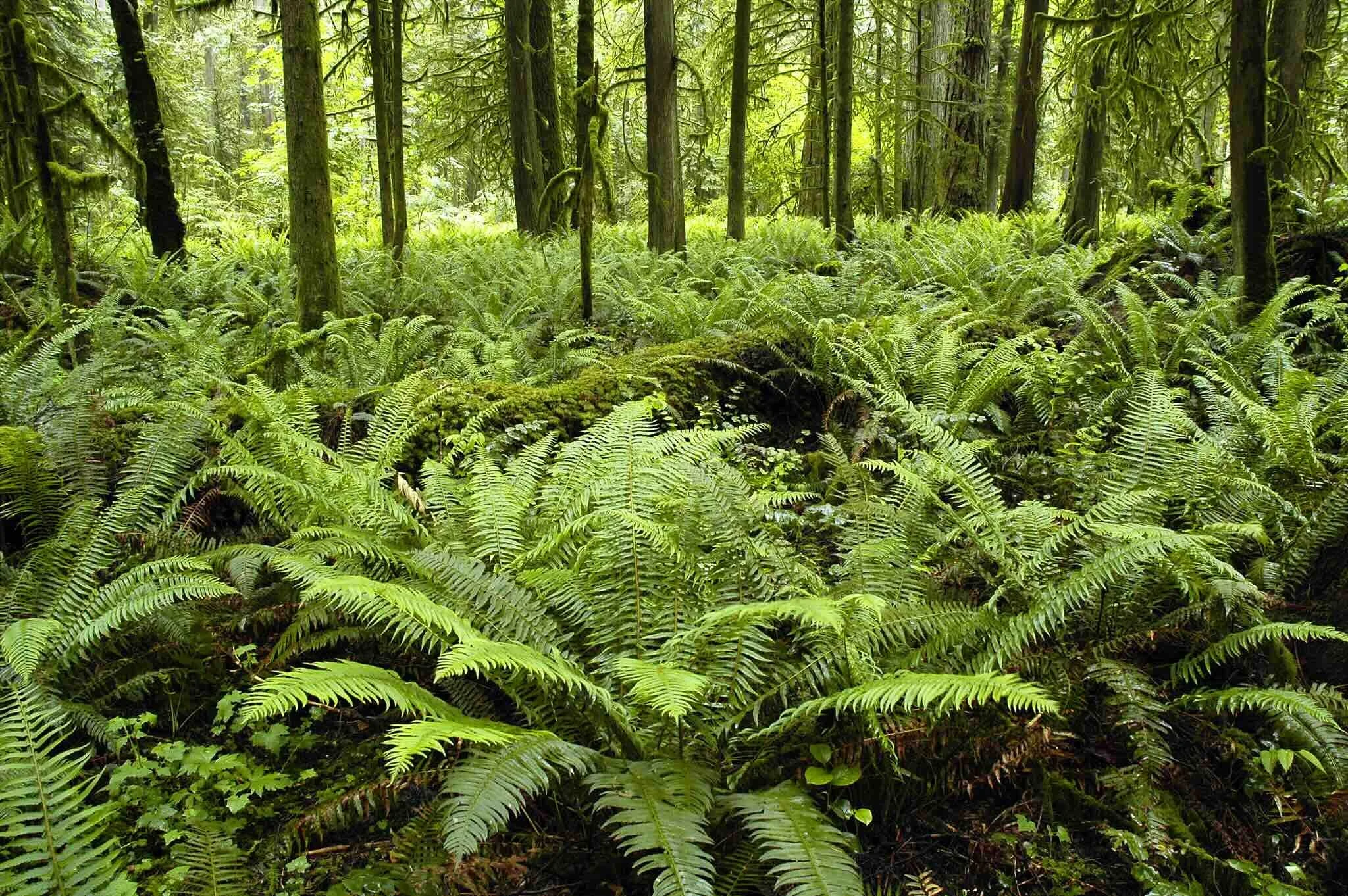
Rising out of the forest floor in a fountain of emerald green, the western sword fern (Polystichum munitum) is a gorgeous example of one of the oldest plant lineages on earth. Prized across its range for its myriad uses, the plant is culturally important to many Indigenous peoples. Western sword fern supports several species of native wildlife, making it a great addition to shady spots in your green space.
A Brief History of Ferns
Ferns are among the oldest living plant lineages, first appearing in the fossil record around 393 million years ago. Ferns and their relatives were the first plants to evolve vascular tissues, structures that allow plants to transport water and nutrients throughout their bodies. The advent of vascular tissue allowed ferns and their relatives to grow to much larger sizes than was previously possible, giving them a competitive advantage and allowing them to become one of the most dominant plant groups on earth. If you were to walk through a forest in the Carboniferous Period (58.86 to 298.9 million years ago), you might look up into a towering canopy of ferns, club mosses, and horsetails.
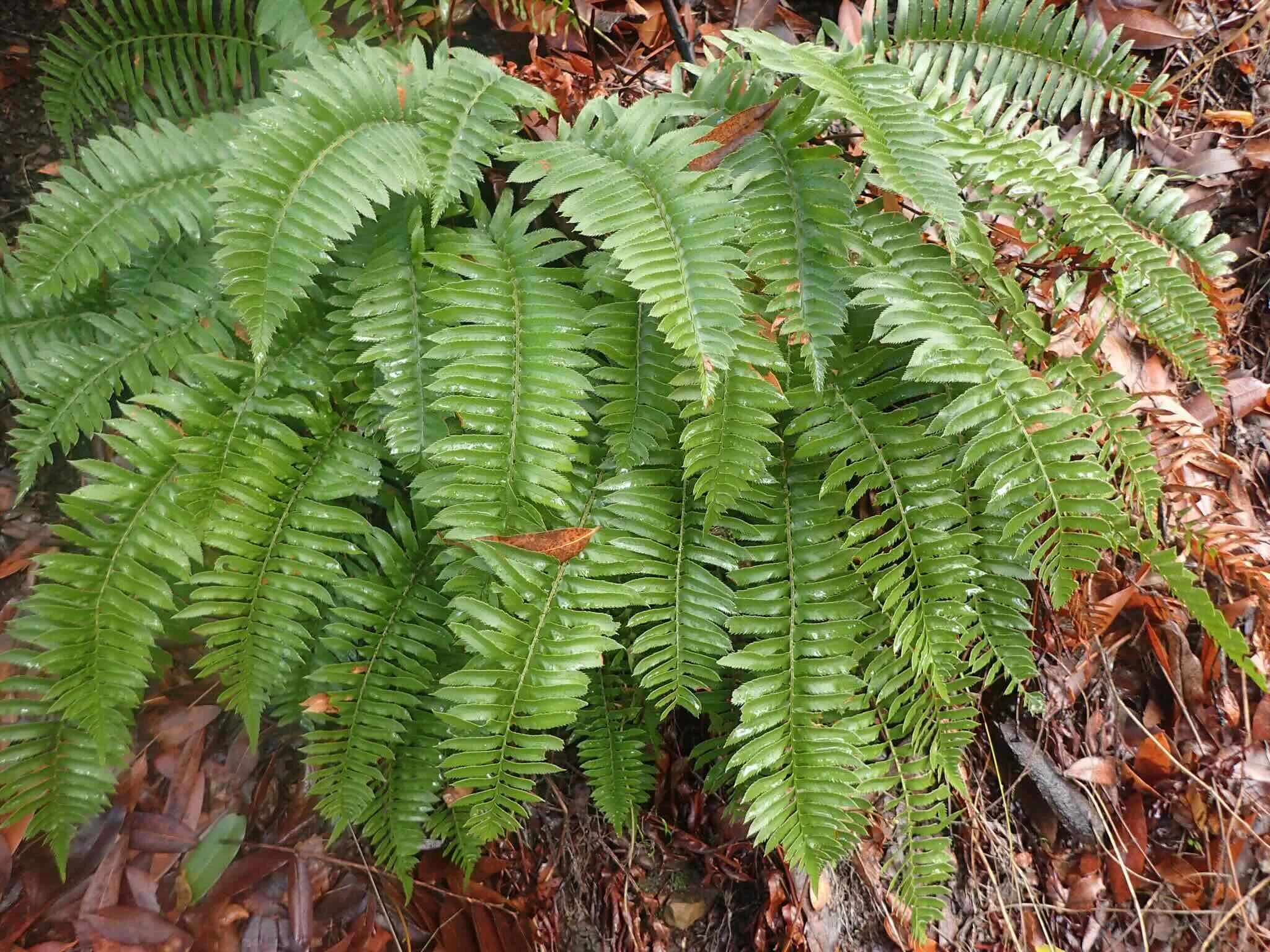
George Williams, iNaturalist (CC BY)
Around 130 million years, a new revolution in plant evolution occurred: the development of flowers. These new plants, called angiosperms, rapidly diversified and spread across the world. Flowering plants outcompeted several plant lineages, but not the ferns. Instead, ferns evolved to fit into the new niches that angiosperm-dominated ecosystems created, such as in the branches of tall trees and in the deep shade of forest floors.
Habitat and Identification
Today, western sword fern can be found in the deep shade of rainy forests and canyons along the North American coast from British Columbia to Baja California, and further inland to shady, rainy sites in the Sierra and Rocky Mountain ranges. Its large green fronds (leaves) are a common sight in California’s redwood forests, where it is one of the most widespread and abundant plants. Individual fronds can live up to two and half years and are an important resource for many animals.
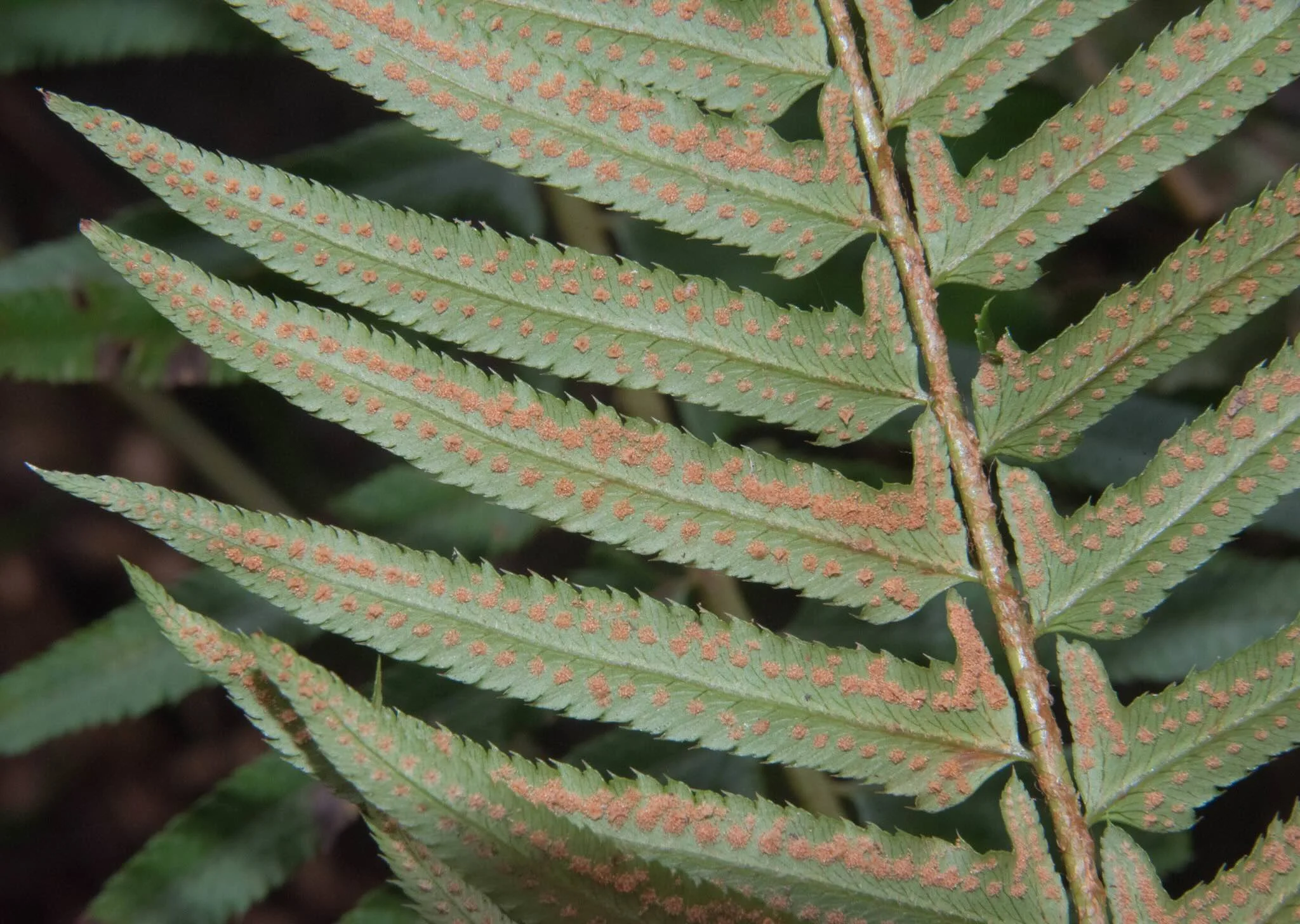
Don Loarie, iNaturalist (CC BY)
Rows of sori on western sword fern’s namesake pinnae.
Western sword fern fronds sprout radially from a central rhizome (an underground, root-like structure), creating a fountain-like appearance. Fronds are divided into smaller leaves called pinnae, and each pinna has a small, upward pointing lobe on its base. Unlike many other large plants, ferns reproduce via spores, similar to bryophytes (mosses, hornworts, and liverworts). Their reproductive structures, called sori, grow in dense rows on the back of each mature pinna.
The sori and pinnae give the plant its binomial name, Polystichum munitum. Polystichum comes from the Greek root words poly and stichos, meaning “many” and “rows,” respectively, referring to the rows of sori on the back of pinnae. Munitum is the Latin word for “armed”, referring to the lobe on the base of each pinna, said to look like the hilt of a sword.
Cultural Uses
Given the plant’s abundance and wide distribution, it follows that Indigenous peoples across its range have found dozens of uses for the plant. The various Ohlone peoples of the Bay Area ate the boiled or baked rhizome of the plant and used fronds to line earth ovens, as did the Pomo of Northern California. The Yurok also used western sword fern fronds to create bedding. These uses are common across the plant’s range, and there are dozens of documented medicinal uses for the plant among the Indigenous peoples of the Pacific Northwest.
*Note: Do not eat or utilize wild plants unless you have confidently identified the species, harvested according to relevant laws/permissions, and prepared them according to the proper protocols.
Growing Western Sword Fern at Home
Western sword fern provides food and resources for a variety of wildlife: large mammals like black-tailed deer and elk eat the fronds, and dead fronds provide nesting material for several native birds and rodents. Additionally, western sword fern is a likely host plant for at least three native moth species. Plant western sword fern in partial to deep shade; it tolerates slow-draining soil well. It grows well alongside other shade-loving plants, such as hairy honeysuckle (Lonicera hispidula), Pacific bleeding heart (Dicentra formosa), native alumroots (Genus Heuchera), and native irises (Genus Iris).
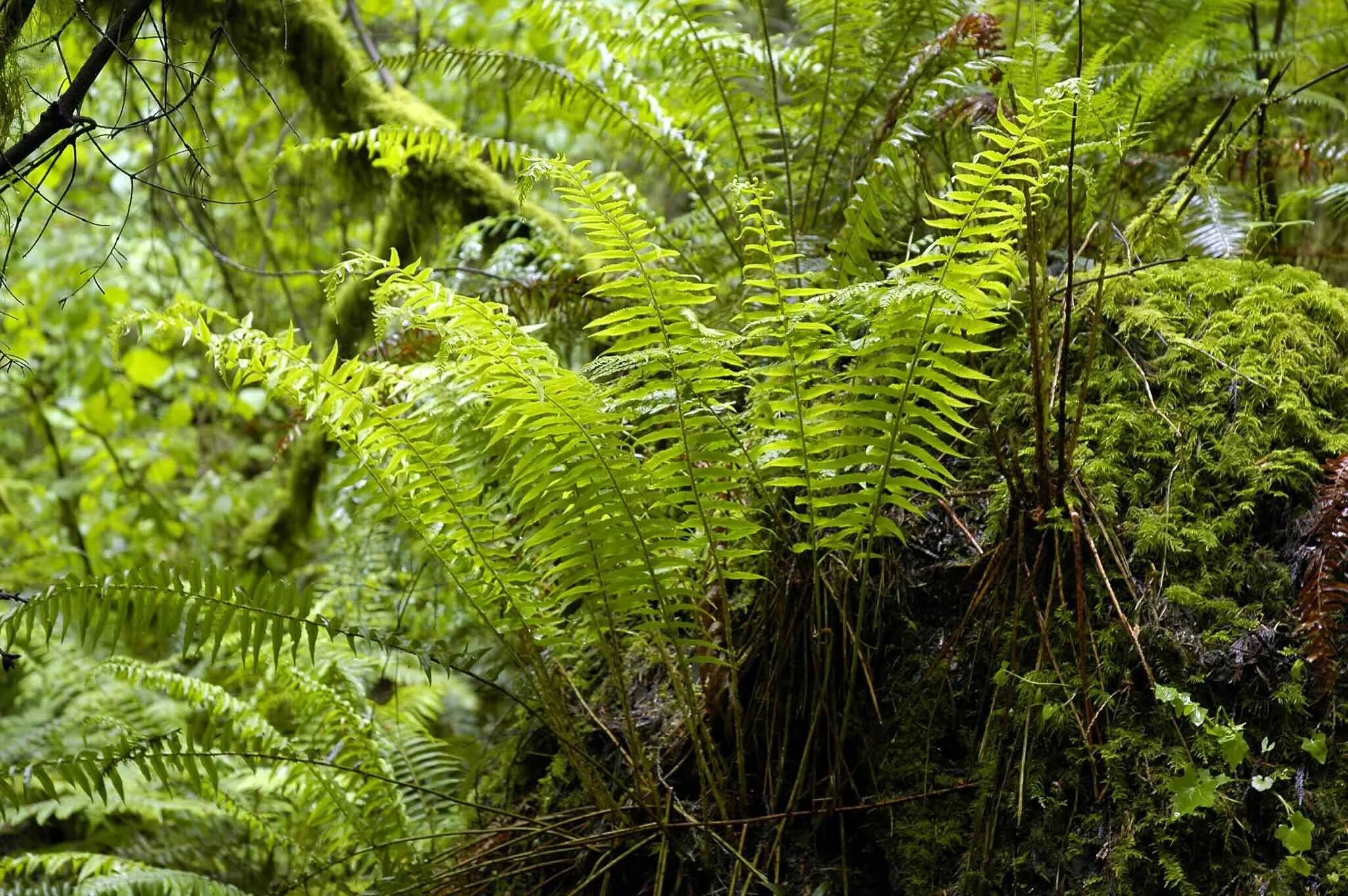
Ferns are often overlooked in discussions of plant life in favor of plants with seemingly more complex structures, such as flowers and seeds. But by any metric, ferns are an evolutionary success story: they are diverse, abundant, and spread across the globe. Ferns like the western sword fern can remind us that simplicity, flexibility, and resilience are powerful strategies for life.
Where to Find Western Sword Fern and Other Native Plants
Western sword fern grows wild across the Bay Area, including at Bear Creek Redwoods, Russian Ridge, Windy Hill, and Foothills Nature Preserve, especially along the Fern Loop Trail. If you want to add a western sword fern to your green space, our AIR-certified nursery grows western sword fern and other native plants using seeds, divisions, and cuttings carefully sourced from local watersheds. Grassroots Ecology employs best management practices to ensure clean nursery stock. See our latest inventory for online sales here:
By Clara Sorensen, California Climate Action Corps Member