Invasive Plant of the Month: Milk Thistle
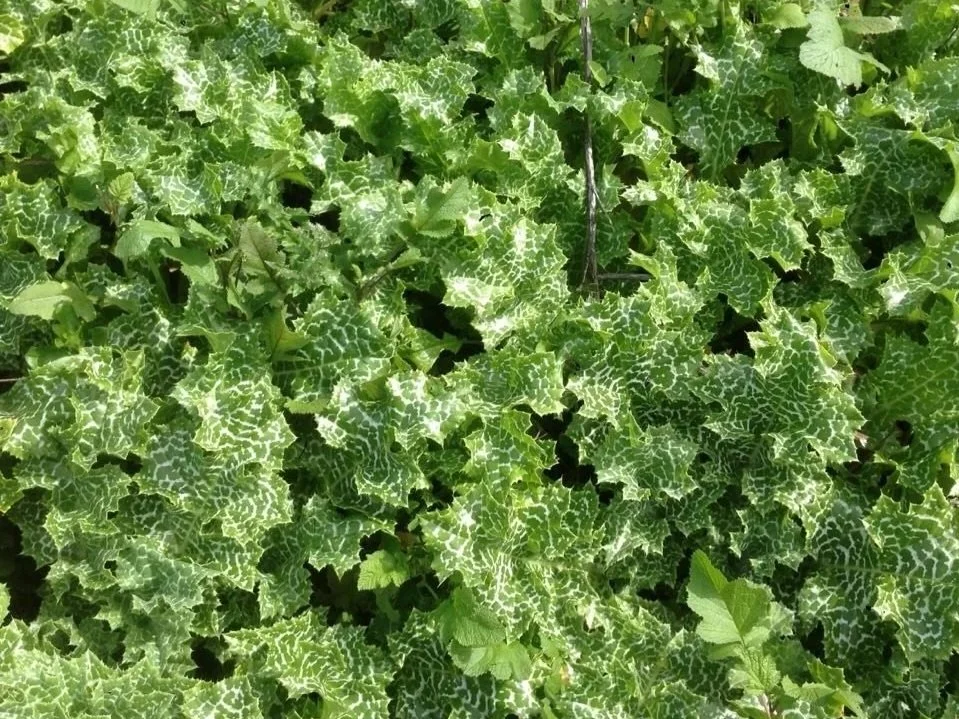
What’s green and white and spread all over? In much of California, at least, the answer is Silybum marianum, or milk thistle. Despite this plant’s attractive foliage and traditional medicinal uses, it has a habit of spreading in disturbed native habitats. Read on to learn more about milk thistle and how you can help!
Identification
Milk thistle shares traits with many other thistles, including their infamous spines. You can most reliably identify them by the milky-white marbled pattern on their leaves, which become slightly wavy as they grow and clasp the flowering stem at the base. Milk thistle can act as either an annual or biennial, and their large, bright pink to purple blooms, which can be seen from February to July, form compound flowering heads, identifying milk thistle as a member of the Asteraceae (sunflower) family. These heads can be very prominent at over six feet tall and several inches wide.
Ethnobotany
Milk thistle is native to the Mediterranean region, where they have historically been cultivated for their medicinal uses. The first known reference to milk thistle as a medicinal herb was in a text by the Greek physician Dioscorides, who lived from C.E. 40-90, nearly 2,000 years ago! Milk thistle produces a chemical compound called silymarin, often extracted from the seeds and traditionally used for the treatment of liver disorders, among other health issues.
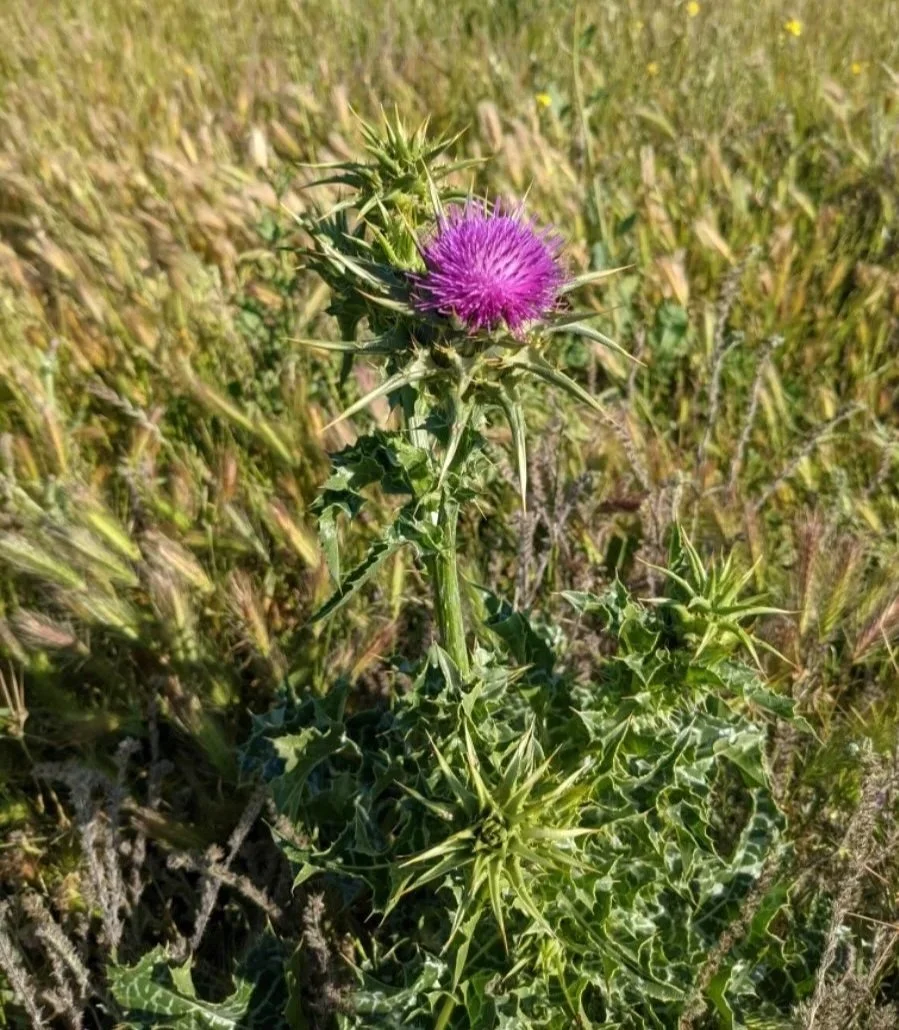
A flowering milk thistle shows off an attractive flower and many, many frightening spines.
There is also some evidence of lactation benefits from taking silymarin, and the scientific species name “marianum” is actually inspired by Mary, mother of Christ, the white splashes on the leaves apparently reminiscent of her breast milk. Today, though more studies are needed for better insight into silymarin’s efficacy, it’s common enough to be found in your local grocery store’s supplement aisle.
Ecology and Invasiveness
Milk thistle prefer to live in places with partial to full sun exposure and disturbed soils, where they can form dense stands. This behavior can quickly crowd out native plants as the milk thistle outcompetes them for space, water, nutrients, and light. Milk thistle also has the potential to be allelopathic, meaning they produce chemicals that inhibit the growth of other plants.
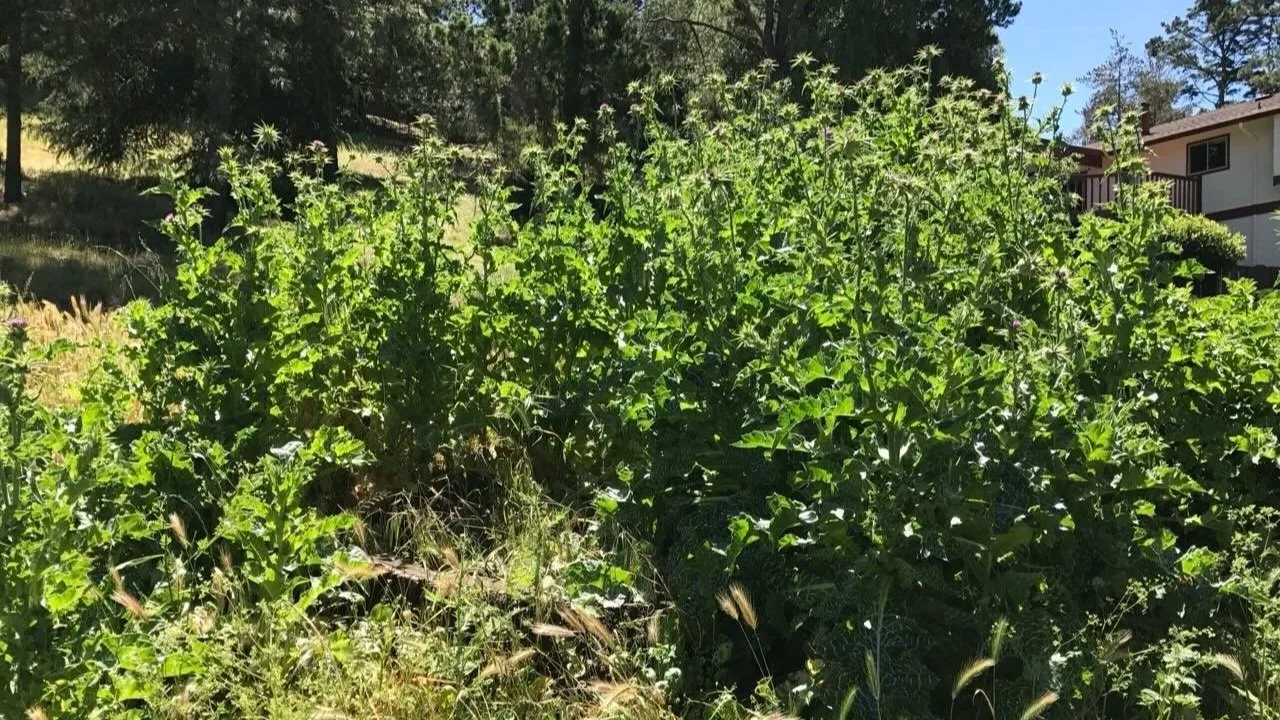
It’s ironic that milk thistle was likely introduced to California via cattle feed, given that the plant can be toxic to many livestock, including cows and sheep. Goats, with their famously tough digestive systems, are one of the few animals that can (literally) stomach the plant. Additionally, the plant’s spines can injure livestock, wildlife, and humans alike. Milk thistle flowers can provide a nectar source for pollinators and a food source for birds, which distribute the seeds. Each plant can produce over 6,000 fruits and the seeds can remain viable for as many as nine years. This makes removal an iterative process, requiring years of diligent management.
Management
Grassroots Ecology manages milk thistle at many of our sites, including Byrne Preserve, Foothills Nature Preserve, Pearson-Arastradero Preserve, and McClellan Ranch Preserve. Our primary removal method is simply pulling them out—while there isn’t the risk of rhizomatous spread, it is important to remove as much of the root as possible to prevent regrowth. Mowing can be an effective technique, though it can take multiple treatments over several months, as milk thistle can resprout from their taproots.
If reading this isn’t enough and you’ve got the itch to manage invasive species in person, come join Grassroots for a volunteer day! Most of our milk thistle management occurs in the early months of February to May, and now in summer we’re in the midst of a big push to remove its somewhat less prickly cousin, yellow star-thistle (Centaurea solstitialis). Check out our events page to learn more—we’ll see you there!
By Wyatt Mosiman, Watershed Stewards Program Corpsmember